Showing posts with label travel. Show all posts

Monday, 26 December 2011

Random Thailand thoughts

I write this from an internet cafe in Chiang Mai, while next to me a young Buddhist monk in orange robes is busily updating his Facebook status.

That to me says a lot about the kind of place Thailand is.


Thais are such an easy-going and friendly people that it's hard to imagine how country has been riven with violent political protests of late, or how police corruption is such an enormous problem. But that peaceful nature is clearly a must when dealing with Bangkok's notorious traffic. Apparently it's no longer the worst in SE Asia - Jakarta has claimed first prize there - but that says more about what's wrong with Jakarta rather than Bangkok getting any better. Jakarta's public transport system is still barely a notch above dysfunctional, and Bangkok's is outstanding as developing countries go.


I ducked into a pharmacy in Bangkok's mammoth Mah Boon Krong (MBK) shopping centre the other day as I needed to buy some moisturizing cream. (I like my skin to be baby smooth, okay? Don't judge me.) However, it was almost impossible to find any product that didn't trumpet it's "whitening" property as it's greatest asset. I'm quite white enough already, thank you. It's sad that this sort of thing is endemic throughout Asia. The beauty of Thai women is well-known around the world, and despite what most Thais probably think, I'm guessing that having a slightly tanned complexion is part of the reason.


I've written before about Thai names and how they just happen to sound very rude or funny when written down and read by English speakers. I won't add too much to what I've said before, but I'll just mention a few random place names: Gaysorn Plaza, Chong Nonsi, On Nut, and Udom Suk. Oh and let's not forget Anusarn Market.

One thing you may not know is that Bangkok has one of the largest Sikh communities in the world - they make up the vast majority of the 105,000 Indians resident in this city, and most have dual Thai-Indian citizenship. It was this community that brought me to Thailand to celebrate the 4-day wedding of Punjabi friends (he's from Bangkok, she's from Kuala Lumpur). Ending the celebrations by driving off in a "Just married" tuk-tuk was a brilliant touch.


I'm quite conflicted about the multitude of white guy - Thai girl couples that I see everywhere in Bangkok. On one hand, I try not to judge people too much since I don't know them - if I had a SE Asian girlfriend and we went to Thailand together, I'm sure people would look at us in a certain way, and I don't want to leap to conclusions. On the other hand, something about it just creeps me out. On the other hand (I have a lot of hands), if both parties are getting some mutual benefit out of it, then maybe that's a good thing. Then again, there are a helluva lot of victims of many Western men's view of Bangkok as a place to come and satisfy their less saintly urges, and many don't really have a say in their fate.

What bars (both cool and creepy) are to Bangkok, coffee shops are to Chiang Mai. They are everywhere, all with espresso machines and free wi-fi. While this could imply that northern Thais are a bunch of latte-sipping, facebook status-updating yuppies, it's probably more likely that it reflects the different breed of tourist that arrives in Chiang Mai as opposed to Bangkok. Most of them wear fisherman pants.

Speaking of coffee, order a cappuccino in Chiang Mai and odds are it will be dusted not with chocolate but with cinnamon. Which is actually an improvement, to my tastes. But the real coffee to try is kopi boran, meaning "ancient coffee". It's not that ancient really, but appears to be what Thais call any coffee that's neither espresso-machine-based nor Nescafe instant. Kopi boran is usually filtered through what looks like a large sock, and will probably be served with condensed milk unless you ask otherwise. I really like the muddy brew, but then again I tend to like condensed milk in things.


The Dome hotel in Chiang Mai has a ginger cat that rides the elevators like it ain't no thang. That's not necessarily a reason to stay there, but I just thought it was awesome. Like most cats, it has a major sense of entitlement.

Monday, 14 February 2011

Tiger Airways - a cunning predator of the unwary

Budget airlines are tricky creatures. Bless them for bringing extra competition to the market, but my goodness can they be sneaky. AirAsia, who I fly with regularly, have some sneaky tendencies as their web-booking system attempts to sneak a few sneaky hidden charges past you as you blithely click through - but I have found it to be mostly harmless, if a bit too sneaky.

This past weekend I flew Tiger Airways for the first time. And probably the last.

A scan through the interwebs will reveal a variety of complaints - poor service, delays, cancellations, hidden charges - about Tiger, which is based in Singapore but runs many domestic flights throughout Australia. What put me in a foul mood for a sizeable chunk of my weekend was Tiger's online check-in policy. Lots of airlines offer online check-in option these days, and generally it's a good thing which can save you time you might otherwise spend in a queue. But Tiger give it a twist and charge you money if you don't check in online.

Turn up to their counter without having checked in, and they slug you with a fee of $25. According to this news story, it was only $15 barely 8 months ago. (And yes, I wish I hadn't only read that article just now.) Now technically speaking, this information is available when you book the flight, but it's not completely obvious - it's unclear enough for lots of people to miss it, anyway. And given that most people book flights more than a week in advance, it is easy to forget that there even was an online check-in option, which is what happened in my case.

So my very first experience of walking into a Tiger terminal was being hit up for an unexpected $25. I'm sure you'll agree it's not a good first impression. I hadn't even got on board the plane yet and already I was vowing never to fly with them again. And if you are thinking that perhaps I'm the only fool to get caught with this fee, the person at the counter next to me also got stung, as did the couple in front of me on the return leg. I saw the wallets come out, and the looks of bewilderment and disgust on their faces.

Now $25 is not all that much money, you might say. And Tiger has every right to have this as their policy if they wish. Fair enough.

I just don't like businesses that treat their customers with contempt. Because no matter how Tiger's Australian Managing Director might mouth things like "It's about unbundling all the extras and being transparent about all charges to allow customers to tailor their travel needs to their budget", the web check-in is ultimately just a trick to bleed some extra money from unsuspecting customers. And those are customers who will feel cheated, start their journey on a sour note and be less likely to fly with Tiger in the future.


The thing is, Tiger clearly thinks that making that $25 is worth that horrible first impression. And that ethos fills me with contempt. For all AirAsia's hidden charges, they still itemise it for you before you decide to pay, so you can see what you have unknowingly upgraded to, so they are not all that hidden.
I also experienced delays on both of my flights this past weekend. About 30 and 45 minutes, which is not horrible in the scheme of things. But given that Tiger staff are well-known to be obsessively rigid in punishing anyone who turns up even a minute after the designated check-in time, it's kinda poor form for them to routinely have late departure times. If I turn up late for check-in and simply said "I apologise for the inconvenience caused", would their staff accept me with the same shrug of their shoulders with which I am expected to accept their apologetic voiceover?


My colleague and his family once flew Tiger to his holiday destination, and for the return journey turned up to the check-in counter 5 minutes late (he'd rushed there from a medical clinic because he'd been bleeding out of his ear). No amount of negotiation or begging would convince the Tiger staff to let them check in, which meant their tickets were wasted. (I'll bet as well the plane was delayed more than 5 minutes, btw.) To get home in a timely fashion, they had to purchase tickets with another airline, which cost my colleague over $1000 extra. Now, it is not uncommon for airlines to enforce this cut-off time with some rigidity, but you have to wonder. They didn't really gain anything by forbidding these people from boarding - the seats had already been paid for, and now they would just be empty. But the cost to them is that one family will certainly never fly with them again, and each member will undoubtedly spread the bad word to friends and acquaintances (unfortunately, not to me - I only heard this story after venting my own annoyance with the airline).

It seems to be terrible business practice, but one that is totally consistent with Tiger's way of doing things.
I'll say in fairness that while a couple of the Tiger staff I dealt with on the plane and on the ground were surly, the rest seemed pleasant. And Tiger does still fill a purpose - it has a slight lowering effect on the prices of other airlines through the power of competition.

All budget airline tickets need to be purchased with care - sometimes it does pay to read the fine print. As I said, they are a tricky species. But Tiger seems to be vying for the title of the trickiest of them all. Perhaps, as the saying goes, you get what you pay for after all. Caveat emptor.

Saturday, 20 November 2010

Philippines tourism campaign takes an unfortunate porny twist

The Philippines says it pulled its latest online tourism campaign after critics panned the rebrand and warned that unwary surfers could easily end up at a porn site instead.


The site, www.beautifulpilipinas.com, was taken down on Tuesday, just a day after it was launched by the tourism department to much fanfare, said Evelyn Macayayong, interim head of the ministry's tourist information office.
The campaign featured a candy-coloured logo including the slogan, a coconut tree, an endangered primate called a tarsier, the sun and waves.
Critics panned the decision to use the local spelling of the country's name, warning that a similar site, with a spelling only two letters different, was pornographic.
Some called for the country's eight-year-old tourism slogan, "Wow Philippines", to be brought back.
Posts on networking sites about the "Pilipinas Kay Ganda" (Philippines What a Beauty) website described it as "bland," and "lacking punch".
In response, Macayayong referred AFP to Tourism Minister Alberto Lim's speech at Monday's launch.
"It is a radical departure from what our neighbours are doing, and to the faint of heart, a bit risky," Lim had said, defending the rebranding as a result of market research conducted by an unnamed major advertising firm.
 (Source)

Now I'm not in the marketing industry, but I would assume that one of the most important tenets in marketing is to know your audience. So I get that in Tagalog, the name for the Philippines is "Pilipinas"; however, to the non-Filipino, it recalls the word "Filipinas", meaning Filipino women. So I think it's understandable that the vast majority of people who see a website called www.beautifulpilipinas.com, are going to suspect that it is, if not a porn site, at least one devoted to the Philippines' many beautiful women, rather than the beauty of the country itself.
Now I'm a curious fellow, so in the interests of research, I searched on www.beautifulpilipinas.com (the website no longer exists) and then changed the p to an f and awaited the result.
Good heavens. Now I'm a red-blooded male and I don't consider myself a prude but the site I ended up on  was a little too much for my senses. And it didn't even seem to feature any Filipinas! It would certainly have painted the Philippines as an interesting place for all those potential visitors who inadvertently spelled the original website's address wrong. But I'm guessing the Tourism Department don't want the world thinking the Philippines is the place you go to see Latin chicks getting gangbanged.

So I'm glad they pulled it, and I'm sure they'll learn for next time. These are the things you need to consider when operating in the internet age. So if you are setting up a website for your business that sells big black clocks, I hope you learn from this too.

Tuesday, 9 November 2010

Images of Yogyakarta, Indonesia

Yogyakarta, located in central Java, is a small city of around 400,000 people, known both for its bustling street life and its place as a heartland of traditional Javanese culture. It maintains a balance between the old and the new; cars, buses and motorcycles compete with the more laid-back pace of pedal-powered becaks.

 Above: Eating lesehan-style (on mats by the roadside) is one of the signature experiences of Jln Malioboro, the street that Yogya seems to revolve around. The food is good but not necessarily the best Yogya has to offer - you need to sniff around a bit further for that - but it is a must for those who enjoy observing the energetic hustle and bustle of street life.
Above: Yogya is famed for its ayam goreng (marinated fried chicken), and part of the appeal surely is due to the use of kampung (village) chickens rather than factory-farmed ones. Hopefully this fellow's handsome demeanor will save him from the deep-frier.
Above: Naga statue at the Kraton (Sultan's palace)
Below: The bird market in the south of the city, which bears the rather odd title of PASTY (an acronym for Pasar Satwa & Tanaman Hias Yogyakarta)


Left, right and below: Tamansari (Water Castle), designed in the 17th Century by a Portuguese architect overlaid by traditional Javanese motifs.

Above right and left: A craftsman painstakingly creates a wayang kulit hand puppet, made from the hide of water buffalo.
Below: Wayang kulit in action, depicting the great Hindu epics of yesteryear.

All these photos courtesy of Aveena, who also has a photo blog here.


Related posts:

Gudeg, the ugly but beautiful culinary specialty of Yogyakarta

Chinese donuts on a Yogya roadside - the best breakfast ever

"Cat-poo coffee"

Wednesday, 27 October 2010

Being vegetarian in Indonesia

Indonesians, like pretty much every other nationality, are people who like eating meat. While some other Asian countries have some tradition of vegetarianism due to their Hindu or Buddhist faith, Indonesia is a Muslim country with no such tradition. In my recent post about being vegetarian in Malaysia, I pointed out that while meatless Malay food is hard to come by, vegetarianism has significant roles in the cultures of both the Chinese and Indian minorities, making meat-free food quite easy to come by in Malaysia. But such large minority groups do not exist in Indonesia (the Chinese are only about 2% of the population, and tend to be great meat-eaters anyway). So what do you do if you are in Indonesia and you don't eat meat?

Well actually, vegetarians can eat really well in Indonesia. With just a little knowledge, they can probably do better than in most Western countries.

One reason is that Indonesia is a poor country. Meat, as it is in most places, is expensive, and this makes it something of a luxury. For this reason many Indonesians will not eat meat every day, even if they would like to. Instead, they turn to cheaper sources of protein - eggs and soy products.

Meat is seldom the focus of the meal; as with most Asian countries, everything revolves around rice. Indonesians consume it in large quantities; meat and vegetables are really just side dishes to add accent to the rice. This means that vegetable dishes are usually more highly flavoured than in most Western cuisines (where meat is the star and vegetables are often a bland accompaniment). Indeed, Indonesians abroad tend to find Western food to be somewhat tasteless and have a need to add chili to everything.

It's important to state before I go any further that Indonesia has around 300 separate ethnicities, so talking of "Indonesian food" is almost as problematic as talking about "European food". Eating habits change from place to place due to factors such as religion, cultural influence and the local economy. Some regions feature a diet based primarily around fish. In some regions pork is the meat of choice, but most Indonesians (being Muslim) would recoil from the thought of eating pork.

I'm aware that there are some vegetarians (from certain Hindu and Buddhist traditions) who do not eat alliums (aka the onion family). If you are such a person, you will struggle immensely in Indonesia, because shallots and garlic are the basis of virtually every Indonesian dish.


If you are one of those vegetarians who eats seafood (a strange concept to me, but anyway...) then you will rarely if ever have a problem getting decent food in Indonesia. The affordability and relative abundance of seafood means that Indonesians eat it frequently, and you will find warungs selling things like ikan bakar (grilled fish) and pecel lele (deep fried catfish with sambal) everywhere.

If you don't eat seafood, you'll have to decide whether you can turn a blind eye to it from time to time. Because like all other Southeast Asian nations, Indonesian cooks are fond of using seafood products to flavour dishes that would otherwise be vegetarian. If you are a strict vegetarian who wants nothing to do with any of this fishy business, you need to make sure you know thine enemy. These can take several forms:

ebi or udang kering (dried shrimp)
terasi (shrimp paste)
petis (fermented shrimp paste, black in colour)
ikan teri (dried anchovies - what the Malaysians call ikan bilis)

All get mixed into stir-fries, stews and curries to add a savoury flavour element. So keep an eye out, and you may want to ask if a dish contains them. Terasi is used in the same way as its Malaysian equivalent belachan, usually as part of a chili sambal, but it is not as ubiquitous as in Malay cuisine. It is sometimes very hard to detect in some recipes, as the amount is rarely overpowering.
It should be stated that none of these seafood products are used anywhere near as frequently as fish sauce is used in Thai or Vietnamese cooking.


Vegans
Now if you are a vegan, I won't kid you; you are gonna struggle. But you probably struggle most places you go, so I guess you are used to it. But there is plenty of bean curd and tempe available almost everywhere. Avoiding dairy is no great problem; traditional Indonesian cuisine does not really use any dairy products at all, although condensed milk and evaporated milk do turn up in various desserts and drinks. Indonesians are very fond of eggs though, and use them in a variety of ways. If you tell people you don't eat meat, the first option they will think of as a substitute protein is usually some kind of egg preparation; so if you don't eat eggs, make sure your hosts understand this.
Words and phrases to learn:
Sayur/ sayuran - vegetable(s)
Daging - meat
Tanpa daging - without meat.
"Saya tidak makan daging" - I don't eat meat.
"Saya tidak makan telur" - I don't eat eggs.
"Ada yang tidak pakai daging?" - Is there anything that doesn't have meat?
"Saya mau makan sayuran saja" - I only want to eat vegetables.
"Saya vegetarian" - I'm vegetarian (obviously). Don't take it for granted that all Indonesians are familiar with this term though.


Tahu (Bean curd)
The sheer affordability of bean curd makes it one of the most common sources of protein in Indonesia. It helps that it is usually served in very delicious ways.
Tahu goreng - fried tahu. Doesn't sound that exciting, but it is frequently boiled with salt before frying, or served with some kind of sambal.
Tahu bacem - marinated for a long time with garlic, palm sugar, salt and spices, before being deep-fried.
Tahu isi or tahu berontak - tahu that is stuffed with vegetables and sometimes shrimp, then deep-fried.
Bakwan tahu - fritters of mashed tahu seasoned with spices.
Kupat tahu - fried tahu, with cubes of compressed rice cake, served with peanut sauce.

Tempe
An Indonesian invention that has become popular with vegetarians around the world, this is soybeans fermented with a kind of mold, and packed together in a firm cake. On its own the nutty flavour is not all that great, but a good chef can do wonders with it. It is also very affordable. To be honest, I find that most non-Indonesian cooks who try to use tempe end up making a hash of it; so if you are going to eat it, best try it in the country that invented it.
Tempe mendoan - tempe fried with green onions in batter,
Tempe bacem - marinated for a long time with garlic, palm sugar, salt and spices, before being deep-fried.
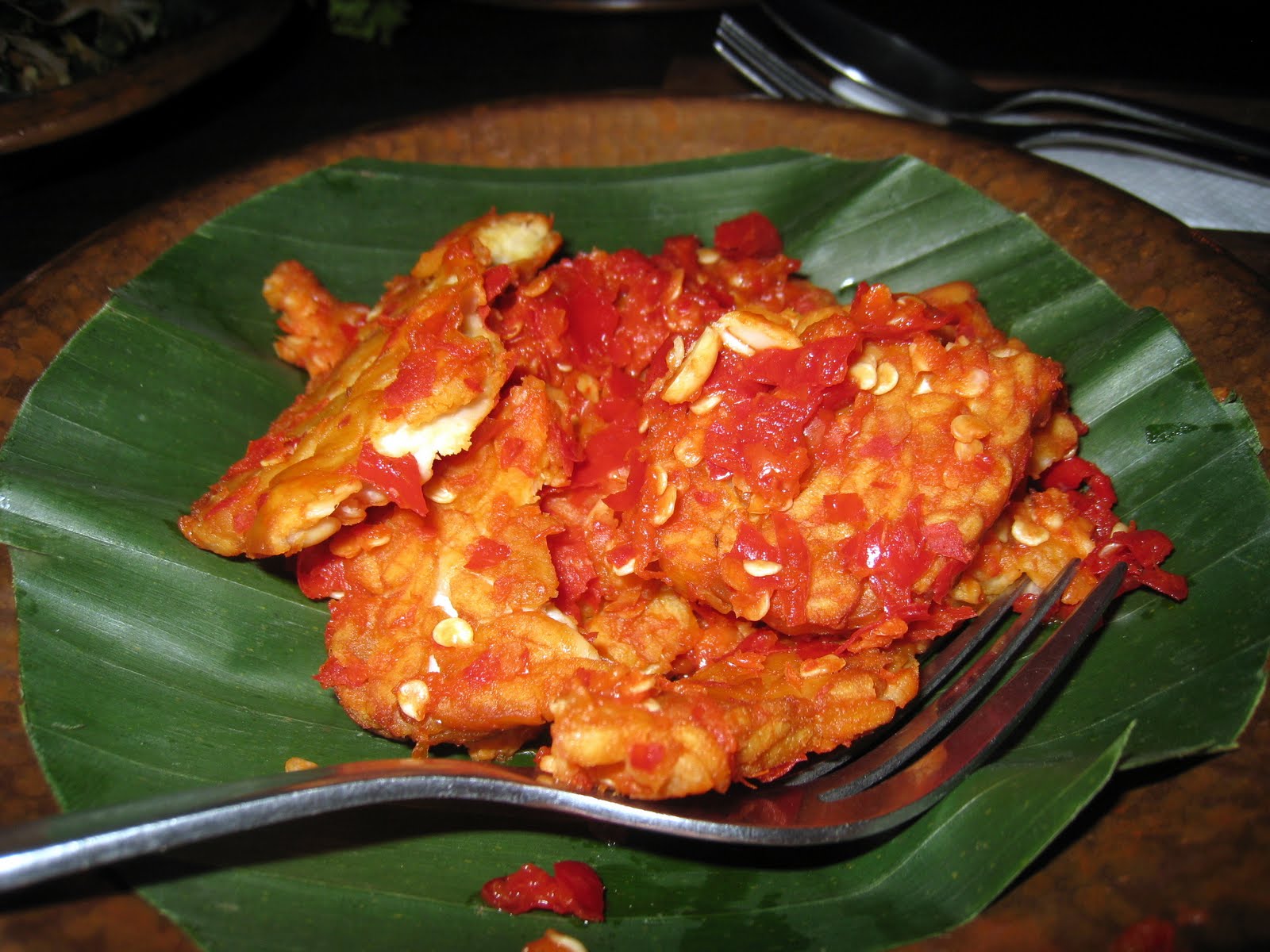
Tempe penyet (pictured) - flattened, fried and served with a fiery sambal.
Oncom - not tempeh but a related product, typically made from soybean or peanut residue fermented with a mold. Sounds dubious, but the Sundanese can turn it into something very special.
Combro - a common street food in Jakarta and West Java, this is a deep-fried rissole of grated cassava filled with a tasty oncom filling.

Gado-gado and its variants:
You'd hate to have a nut allergy in Indonesia, because peanuts are obiquitous, particularly in vegetable dishes. Gado-gado is the best known of these dishes; essentially it is a mixture of cooked vegetables served with a spicy peanut sauce, usually accompanied by lontong (pressed rice steamed in banana leaves). Boiled egg and tofu are often included, as are crunchy crackers of some kind (usually either shrimp-flavoured krupuk or emping made from the melinjo nut).

There are a number of variants on the vegetables-with-peanut-sauce theme to be found throughout Indonesia, depending on which region you are in. In a city like Jakarta, with inhabitants hailing from all over the archipelago, you can probably find them all. Be aware that the peanut sauce may contain a small quantity of terasi, but certainly not always.

Lotek is the Sundanese version of gado-gado and is more or less the same.

Ketoprak hails from Jakarta and is very similar to gado-gado except that it usually contains mihun (vermicelli) and the dressing is based on sweet soya sauce with bits of peanut in it.

Nasi pecel is found in East and Central Java and consists of rice, a variety of vegetables, and peanut sauce.

Karedok is a raw salad (cucumber, snake beans, bean sprouts, cabbage, lemon basil and other vegetables) from the Sundanese cuisine of West Java, with a sweetish sauce, usually containing peanuts and loaded with chili and often terasi.

Rujak - a salad of fruit and sometimes vegetables, in a dark, sweet and spicy sauce that frequently contains peanuts and more often than not will contain terasi. There are numerous variations on this theme.

Nasi campur (or nasi rames)
Meaning "mixed rice", this style of eating is very common; get a plate of steamed rice and choose from a selection of home-style side dishes. Most will be meaty, but you are almost certain to find something vegetarian. However, don't be too surprised if you find yourself picking small bits of meat or prawn out of a dish that otherwise seems vegetarian.

Padang (Minang) cuisine
Padang restaurants serve their own regional take on the mixed-rice idea. Hailing from the Minangkabau ethnic group of West Sumatra, Padang cuisine has spread all over Indonesia and is extremely popular. The success of this cuisine is down to the Minang people's entrepreneurial spirit as well as its deliciousness. A Padang meal always revolves around a mound of hot rice, a cup of hot tea, and a wide variety of cooked side dishes served at room temperature. You either help yourself from their display, or they will bring a host of small dishes to your table. You only pay for whichever dishes you take from.
Padang food is dominated by meat, but there will always be vegetable dishes to choose from. These usually include:
Fried tahu and tempe
Boiled daun singkong (cassava leaves)
Boiled egg in a spicy coconut gravy
A stir-fried vegetable or combination (bean sprouts, eggplant, leafy greens)

Virtually every town in Indonesia has at least one Padang eatery, and it is a welcome standby for vegetarians struggling to find good food elsewhere.

Nasi goreng and mi goreng
Fried rice and fried noodles are common and ubiquitous. Usually they contain meat, but cooks are always happy to make them tanpa daging (without meat). If you do, you will usually get asked if you want telur (egg) as well, as it is a standard addition.

Sundanese food
If you can overlook or avoid the frequent use of terasi, the food of the Sunda region in West Java is vegetarian heaven. Sundanese women are said to have beautiful skin because they eat so many vegetables. Karedok (discussed above) is a good example.
One of the must-tries of Sundanese food is pepes, which is food mixed with a variety of fragrant spices, wrapped in small banana leaf packages and steamed. While fish and meat are the most common fillings, it is easy to get pepes tahu, pepes tempe, pepes oncom, or pepes jamur (mushroom).

Eating in someone's home
If you have the fortune to be invited for a meal in someone's home, make sure you let them know well in advance that you are vegetarian unless, you want to take your chances. An Indonesian family would normally be more likely to serve up meat, since things like tahu and tempe are not always seen as worthy of serving to guests. While most Indonesians would find the idea of someone not eating meat as a little strange, they should be able to accomodate vegetarian needs easily enough if you ask nicely.
As long as you eat eggs, you will probably be OK when eating in people's homes; I've lost count of the amount of times I've gotten by on rice with a little omelette, some chili sambal and a bit of green vegetable.

But don't wait until the meal is served and then announce that you don't eat meat. This will just lead to an uncomfortable situation for everybody.


Other typical Indonesian vegetarian dishes:
Perkedel jagung - corn fritter.

Tumis sayur (or oseng-oseng sayur) - some kind of stir-fried vegetable, typically snake beans, cabbage, kangkung (water spinach), or taugeh (bean sprouts).

Sayur lodeh - vegetables cooked in a coconut gravy.
Sayur asem - vegetables cooked in a sourish, light tamarind-based gravy.

Terong balado - fried eggplant in a fiery chili sambal.
Telur balado - hard-boiled egg in fiery chili sambal.
Urap - a mix of vegetables steamed with grated coconut and spices.
Sambal goreng kentang - spicy fried potatoes.
Nasi uduk - coconut rice, usually served with shredded omelet and a few other condiments.
Nasi gudeg - a specialty of Central Java based around cooked young jackfruit, rice and several accompaniments which usually include tahu, chicken, boiled egg and buffalo skin. You can get it without the meat easily enough.

See also my review of Payon in Jakarta, which has a plethora of vegetarian dishes.

Saturday, 14 August 2010

Eating at Payon, South Jakarta

Indonesian food is a food of the village, the home, and the roadside stall; it is not a cuisine that always lends itself to fancy upmarket restaurants. There are few establishments I have found that succesfully balance the rugged, vibrant heart and soul associated with the cuisines of tropical Asia with the refined presentation that is usually expected of modern fine dining. Payon is one that achieves such a balance. "Modern" though is a concept open to interpretation, and this restaurant's approach invokes the past as a way into the future.
It seems slightly incongruous with its surrounds, an oasis of high Javanese tradition midst the hustle and bustle of the trendy Kemang area of South Jakarta. With a design modelled after the living compounds of the Javanese aristocracy, the attention to detail is amazing. It's open-plan garden setting does have a drawback though; mosquitos can sometimes be a problem, and it's best to come equipped for that.

The menus are a cute touch.

Payon's food is Javanese and Sundanese. The freshness and quality of the produce used stands out in comparison to what you often find in Indonesia, and the kitchen knows how to get the most out of its raw ingredients. One thing the chefs are hardly shy about is their use of chili, using freshly-pounded sambals that are often searingly hot. To a Western palate, this spiciness might come across as heavy-handed, but that is part of its authenticity. They will certainly give you an option as to how hot you want it, however.


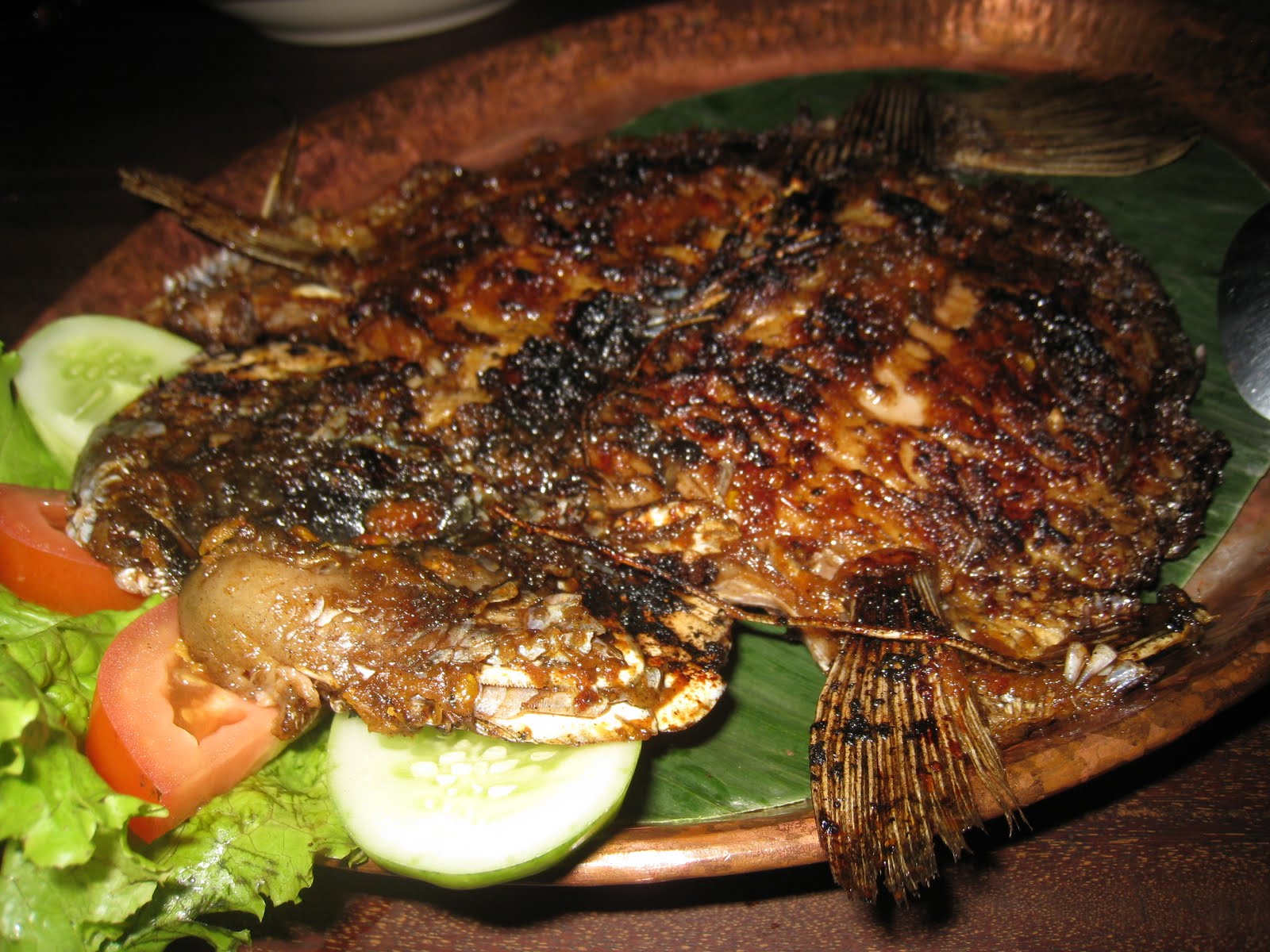
Above: ikan bakar (grilled fish). Below: lencak payon. This is one of the more unusual dishes, and one of my favourites. It is an example of how poor-people's food can be elevated to something of magnificence. Its main ingredient is oncom, a mold-fermented soybean product derived from the leftover sediments from the manufacture of tofu. It is sauteed with spices and contrasts with the slightly bitter kick of lencak (which I think are pea eggplants). A fascinating dish that I've not seen elsewhere.

Below: sambal prawns. It is the little touches that impress me in presentation, such as the mortar made from volcanic stone it is presented atop.


Above: tempe penyet. Below: tahu penyet. Penyet means "smashed" or "flattened", and in this case the tempe (fermented soybean cake) and bean curd are fried, pressed and dressed with a sweat-inducing sambal.

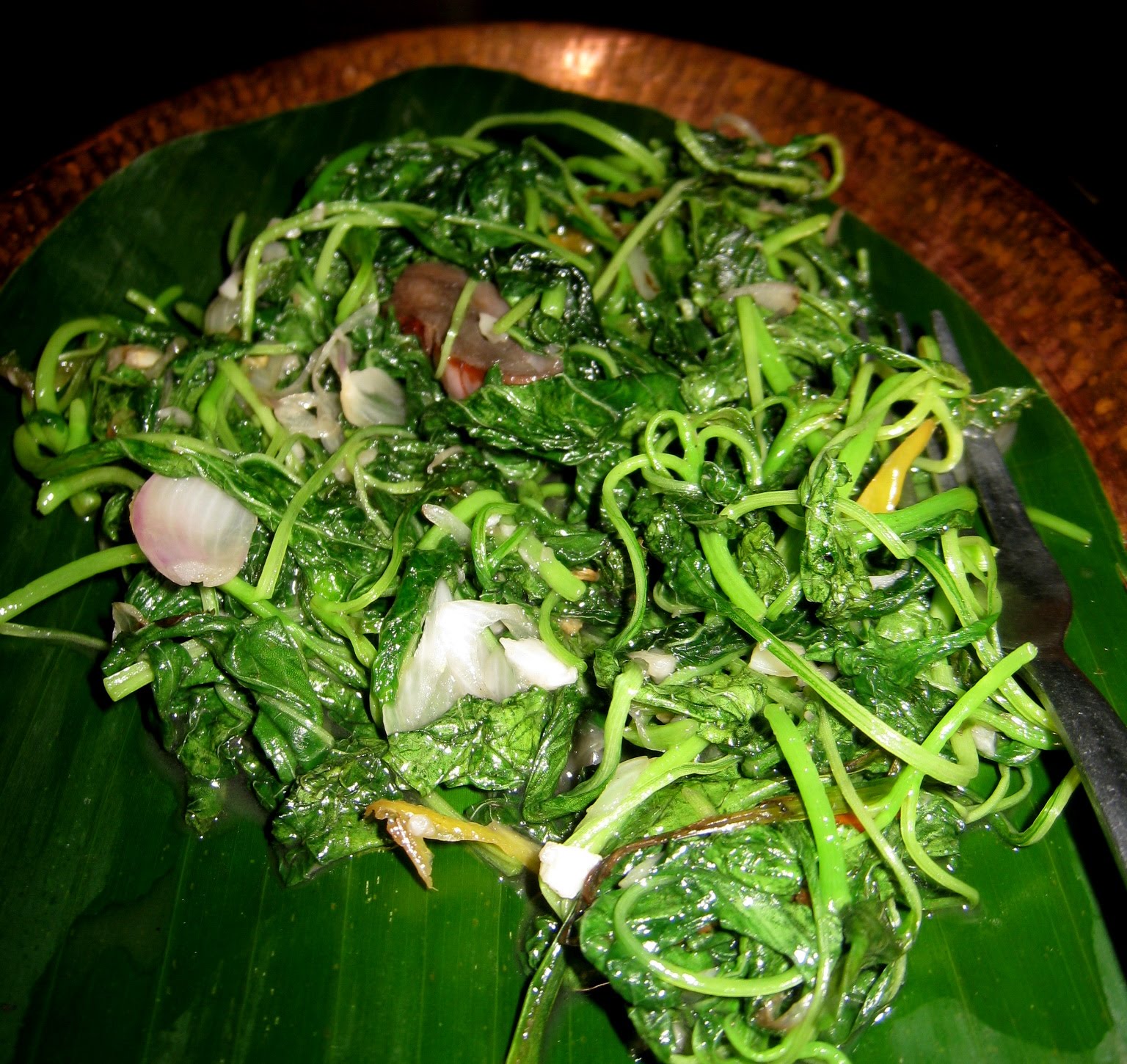
Above: kacang panjang (long beans). Below: bayam (spinach). Both these dishes are simply stir-fried with garlic, shallots, chili and galangal, and display real respect at work for the integrity of the fresh ingredients.


One area which is something of a let-down is dessert, the selection of which is somewhat uninspiring in comparison to the main dishes. On the night in question, we were also informed that many of their vegetables had run out; despite the wide variety of dishes pictured above, there were at least 5 other things we asked for which they didn't have available. These included some of the very distinctive dishes like sambal petai, and stir-fried kecipir (four-angle bean).

By local standards, Payon is somewhat expensive for Indonesian food, but by Western standards it is still amazingly cheap.

My love affair with Indonesian food has been reignited.

Payon, Kemang Raya No. 17, Jakarta Selatan DKI Jakarta. PH 1: (021) 719-4826


See also:


Chinese donuts on a Yogya roadside - the best breakfast ever

Malaysian "carrot cake" - not quite what you'd expect

My encounter with dog meat in Eastern Indonesia

Terengganu cuisine

Penang's famous mung bean cookies

Lina's Popiah, SS3, Petaling Jaya

Ethiopian food at Cafe Lalibela


Thursday, 5 August 2010

Gudeg, the ugly but beautiful culinary specialty of Yogyakarta

"No, we don't need a lift," we told the becak driver in an attempt to fob him off, "we are going to walk to Jln Malioboro for lunch."
"Oh really?" he asked, "What are you going to eat?"

Common sense and Lonely Planet dictate that you be a little circumspect with the becak drivers in Yogya, Central Java. Generally they are nice, but some of them are liable to take you for a ride in more ways than one. And some are a little too persistent to the point of being annoying.

"Gudeg," I replied, referring to a local specialty that I'd been longing to try.
"Well you shouldn't eat it on Jln Malioboro," he advised us, "it's not so nice. Let me take you to the best gudeg in town."
I'm a softy at the best of times, and this guy had managed to wear down my defences. We agreed, negotiated a fee and hopped on.

Sometimes it pays to just let things happen. Because the place he took us to was very good indeed, located on a strip of Jalan Wijilan in which virtually every shop sells nasi gudeg. A "gudeg central" if you will.

Of course, you first need to get past appearances. Gudeg is not the most visually appetising dish, and I could sense that my significant other was a bit sceptical when she saw the display at the front of the restaurant.

Everything is in varying shades of brown. Brown boiled eggs. Murky gray-brown sauce. Brown fried chicken heads. When plated up it doesn't look all that much friendlier, but fortunately I don't eat with my eyes. I had eaten this many years ago as a child, but back then the strange appearance of some of its elements kinda freaked me out. So now that I was an adult in the gudeg heartland, I decided on a re-evaluation.

Nasi gudeg is a selection of dishes served on a plate with rice, which complement each other, much like Malaysia's nasi lemak. One is the gudeg itself, which consists of pieces of young unripe jackfruit, slow-cooked with palm sugar. Jackfruit, like papaya and mango, is used as a vegetable throughout Southeast Asia when in its unripe form; it is also particularly common in Sri Lankan cooking.

Accompanying it is a boiled egg, also cooked with palm sugar until it is firm enough that you could probably bounce it. It is smothered in the murky sauce, which turns out to be a deliciously rich coconut-based gravy.

Then there is the sambal krecek, which is made from buffalo skin, small red beans and tempe, fried with chili sambal. Sort of like eating spicy fat.
Marinated and fried bean curd and tempe also accompany, and usually some cut of chicken. I'm not sure quite why, but fried chicken heads seem particularly popular in Yogya. All served on a banana leaf.

One aspect that some diners will find odd about nasi gudeg is its sweetness. Javanese food as a whole is somewhat sweet compared to many other cuisines, and gudeg in particular is sweeter than what many would expect from a savoury dish. Apart from the sambal krecek, none of the other elements are particularly spicy; Javanese typically do not add chili to their dishes. This doesn't mean they don't like it mindblowingly hot, of course; usually whole chilies or a sambal are served on the side as an accent, with which they can control the amount of chili they eat.
The significant other was won over.

While this is referred to "dry" gudeg, there is apparently another variation of gudeg that we didn't get to try; that version features greater use of coconut milk.

You can get nasi gudeg all over Yogyakarta, particularly at the lesehan (roadside eateries) on Jalan Malioboro at night. However, what we tried there was decent but unexceptional. The best gudeg is found on Jln Wijilan, which is not far from the kraton.

Gudeg Kendil Wijilan "Bu Widodo", Jln Wijilan No. 5, Yogyakarta.

More like this:

Chinese donuts on a Yogya roadside - the best breakfast ever

Malaysian "carrot cake" - not quite what you'd expect

My encounter with dog meat in Eastern Indonesia

Terengganu cuisine

Penang's famous mung bean cookies

Lina's Popiah, SS3, Petaling Jaya

Ethiopian food at Cafe Lalibela